Uncategorized
Want your town to do well? Welcome new people as leaders

The Leadership Myth That’s Holding Us Back The Community Coach | Paula Jensen In small rural communities, leadership matters. But are we unintentionally shrinking our own leadership pool? We care deeply about who leads. We trust the people who show up, pitch in, and carry history with them. But over time, we’ve absorbed quiet assumptions […]
The Leadership Myth That’s Holding Us Back
The Community Coach | Paula Jensen

Paula Jensen
In small rural communities, leadership matters. But are we unintentionally shrinking our own leadership pool?
We care deeply about who leads. We trust the people who show up, pitch in, and carry history with them. But over time, we’ve absorbed quiet assumptions about who qualifies as a leader, and those assumptions may be holding us back more than we realize.
We assume leaders must be deeply rooted in the community: born here, raised here, or long‑time residents. We assume they need years of experience before they’re “ready,” must always be available, and should be fluent in budgets, bylaws, and public meetings. We assume stepping into leadership means sacrificing privacy, family time, or even relationships.
If you’ve ever thought, “That’s not for me,” you are far from alone.
But here’s the truth: real leadership isn’t about being perfect — it’s about being present. Rural communities aren’t built by flawless people. They’re built by people who care enough to show up and are willing to learn as they go.
Leadership isn’t about having all the answers. It’s about asking good questions. It’s about listening well. It’s about loving your community enough to help steward its future. Experience helps — absolutely — but commitment, curiosity, and courage matter just as much.
When we widen our understanding of what leadership looks like, something powerful happens. New voices emerge. Younger residents step forward. Newcomers bring fresh energy. Long‑time community members share wisdom in new ways. Leadership becomes less about who has always done it, and more about who is willing to try.
Think about the neighbor who quietly organizes freezer meals after a tragedy. Or the parent who always arrives early to set up chairs for the school program. These are the instincts of leaders, even if those people never use the word “leader” to describe themselves.
When we actively and intentionally welcome people — before they have to prove themselves — more potential leaders begin to see their own legitimacy. When we normalize learning on the job and make space for respectful disagreement, leadership feels less risky and more possible.
If you care about your town’s future, you are already closer to leadership than you think.
Leading isn’t about being perfect, popular, or permanent. It’s about being present. And our rural communities need more people who are willing to be present.
Here are three low‑risk next steps you can take to move toward leading in your community:
- Serve on a committee or advisory board. Event-planning committees, housing groups, library boards, parks & recreation boards, and economic development task forces are all great on‑ramps.
- Learn how local government actually works. Sit in on a city council, school board, township, or county commission meeting. No pressure. Just listen.
- Map your transferable skills. Have you managed a budget? Organized volunteers? Resolved conflict? Run a business? Raised kids? Those are leadership skills.
If you’ve ever felt frustrated, hopeful, protective, or proud of your community — you already care enough to consider leadership.
You don’t have to decide today.
Just take one step.
Find all Paula’s columns at: https://paulajensenblog.wordpress.com/
Small town marketing secret: Have something to invite people to

People need a compelling reason to leave their homes and come experience your business with you. This feels like a very heavy lift. . You’re supposed to be exciting enough to pull people away from their phones, their families and the comfort of online shopping. You’re competing with everything else demanding their attention. Here’s the […]
People need a compelling reason to leave their homes and come experience your business with you. This feels like a very heavy lift.

A local furniture store hosts two temporary businesses for a special shopping event, combining business-in-a-business and pop-ups to give more people a reason to leave their house. Photo by Becky McCray.
.
You’re supposed to be exciting enough to pull people away from their phones, their families and the comfort of online shopping. You’re competing with everything else demanding their attention.
Here’s the big secret: You don’t have to create all that energy yourself.
Piggyback on What’s Already Happening
Your community probably already has regular events that pull people out of their homes.
Art walks. First Fridays. Girls night out shopping events. Farmers markets. Chamber mixers.
People are already planning to attend these, or thinking about it. Some are already coming downtown or to your area.
Your job is to give them one more reason to show up.
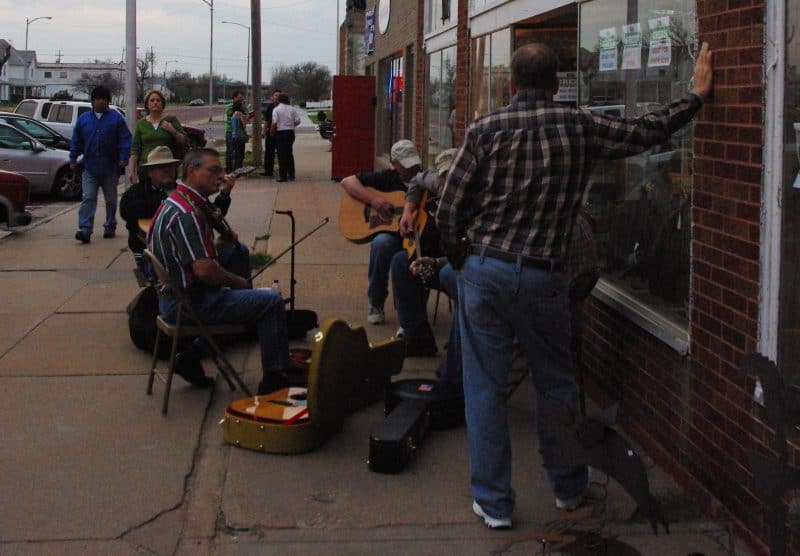
Sidewalk musicians give just one more reason for customers to leave their homes and join the experience. Photo by Becky McCray.
.
What Doesn’t Work: Just staying open during the community event
No experience. No transformation. Just… open, like you are every other day.
That’s not enough.
What Does Work: Make a Thing out of it
You have to create something special that happens during that regular community event. Here are ideas:
- Demos – Product demos, technique demonstrations, how-to sessions
- Mini services – super quick fashion nails, or 5 minute financial boost
- Meet the experts – A real estate agent hosting “meet the lenders.” A feed store bringing in a vet for cattle health Q&A during the farmers market.
- Workshops or mini-classes – Quick skill-building sessions people can actually use. Sounds like a lot for a shopping day, so keep it light and quick.
- Make and take projects – People love leaving with something they created
- Trunk shows or special collection reveals – Show merchandise you don’t normally carry
- Live entertainment – Music, performances, even personal star chart readings (yes, really – Gen Z is into astrology and all that)
- Tasting or sampling events – Let people experience your products
- Q&A sessions or “ask me anything” – Be available for real questions
- Behind-the-scenes tours – Show them what they don’t normally see (people love back room tours)
- Out of town big names – Bring in expertise people want to hear from
Pick one. Make it yours. Do a fresh edition of it every time that community event happens.
You become the tipping point
Someone was thinking about coming to art walk. Then they heard you’re doing that demo they’ve been curious about. Now they’re definitely coming.
You’re not competing for attention. You’re adding value to something people already plan to attend. Or at least thought about attending.
And here’s your new go-to move: When anyone expresses interest in your business but never seems to make it in person? Don’t just “follow up.” Invite them to your special thing during the next community event.
“Hey, I’m doing a live demo during First Friday – would love to see you there!”
You still have to do your regular marketing like mailing postcards, sharing photos, but you’re supercharging it with a deadline. And then you’re layering it with repeated messages.
“Our demo was packed! We’re doing another (a little different) next month!”

Frame shop owner Carolyn Murrow hosted a local photographer in her business’s foyer during an evening art walk in Alva, Oklahoma. Photo by Becky McCray.
The Small Town Reality: Fewer people, less turnout
Yes, rural areas have fewer people. That means fewer potential attendees. Less momentum each time. It’s harder to keep events going on your own.
That’s exactly why piggybacking on existing events is brilliant for small towns. The event is already happening. People are already considering attending. You’re just giving them one more reason to come.
Start Small, Keep Going
- Pick one existing community event.
- Create one simple thing to offer during that event.
- Commit to showing up consistently with your thing every single time.
That’s it. That’s the whole strategy.
You don’t need elaborate planning or big budgets. You need one good reason for people to experience your business, timed to when they’re already planning to be out.
The Opportunity: Most businesses aren’t doing this.
Some businesses might stay open during community events. But most are not creating experiences.
You will stand out.
When you’re the business that always has something interesting happening during art walk, or First Friday, or girls night out – people start planning around you. You become part of why they attend the community event in the first place.
So what’s your thing? And which community event will you tie it to?
More experience-based retail: the Charm Bar, Valentine’s Rose Bouquet Bar

Following up on the trend of rural experience-based retail, I spotted these Valentine’s Day offerings from my local women’s boutique, The Daisy Village. I’m seeing more and more use of the term “Bar” to refer to any assemble-your-own type experience. Think like a salad bar, where you pick just the parts you want, but for […]
Following up on the trend of rural experience-based retail, I spotted these Valentine’s Day offerings from my local women’s boutique, The Daisy Village. I’m seeing more and more use of the term “Bar” to refer to any assemble-your-own type experience. Think like a salad bar, where you pick just the parts you want, but for anything from western hats to charm bracelets.
Experiences are a competitive advantage for small town businesses.
The fun of picking your own ingredients and assembling your own product, plus knowing no one else will have one just like yours, equals an experience that online shopping can’t replace. That’s a competitive advantage.

They combined a pop-up from a bakery with a chance to customize and pickup your rose bouquet. Perfect Valentine’s Day retail ideas.
In the same email, the Daisy announced a new Charm Bar so you can pick the charms you want on your jewelry.

Assemble-your-own experiences build community.
While you’re shopping, picking out your own favorite pieces and assembling with your own personal touches, you’re also talking to other people and being physically present in the community. That helps build a strong local community. It’s part of why shopping locally matters to rural places.
Buy Inventory Online Using Wholesale Apps: Tips for Small Town Retail Stores
I walked into a new local retail shop in Alva, Oklahoma, population 4,000. It’s called Bates & Co., and they are best known for their handcrafted hairbows for infants and kids. But when I walked into their store, they had all kinds of things under one roof: women’s clothes, fashion jewelry, travel accessories and more. […]
I walked into a new local retail shop in Alva, Oklahoma, population 4,000. It’s called Bates & Co., and they are best known for their handcrafted hairbows for infants and kids.

Bates & Co used to be Bates & Bows, known for these amazing hairbows. Photo by Becky McCray
But when I walked into their store, they had all kinds of things under one roof: women’s clothes, fashion jewelry, travel accessories and more. It was a rural women lifestyle kind of shop. I asked the owner where she found all her products, did she go to the Dallas Markets to find them? She said no, she bought from the wholesale apps on her phone.
I was floored! I used to run a retail liquor store, and we could only purchase from approved wholesalers licensed by the state. I had no idea the power of a simple wholesale app on your phone!
So I bet there are other business owners or hopeful future store owners who don’t know that either!

From their beginnings with hairbows, Bates & Co now leverages wholesale apps for inventory that covers a wider rural lifestyle niche. Photo by Becky McCray.
Wholesale apps are your trade show that never closes
If you’ve only ever bought inventory through licensed distributors or in-person markets, this feels almost unreal. But for many retail categories — especially clothing, gifts, accessories, home décor, and boutique-style items — there are wholesale marketplaces that live right on your phone.
And no airfare or hotel bill.
That’s powerful in a town of 4,000.
But it also means you need to be a smart buyer.
Green flags: signs a wholesale app is worth your time
I did a little research on this, and I’m excited about the potential for rural retail businesses! If I were starting with these apps today, here’s what I’d look for first:
Clear wholesale requirements
Legit apps usually require:
- A business name
- An EIN or business registration
- Sometimes a resale certificate
That’s a good sign. It means they’re trying to keep retail shoppers out of the wholesale pool.
Transparent pricing and minimums
You should see:
- Wholesale prices clearly marked
- Reasonable minimum order quantities (MOQs)
- The ability to test with a small first order
You don’t need massive quantities in your small town boutique, so look for apps that understand that.
Real brand information
Look for:
- Brand story and location
- How long they’ve been on the platform
- Reviews from other shop owners
If you can’t tell who you’re buying from, slow down.
Shipping timelines you can live with
Some items ship in days. Others are preorder and ship in weeks. Both are fine — as long as it’s clearly stated, and as long as that works for your business.
Red flags: when to delete that app
These are the things that would make me nervous:
Prices that don’t seem right
If the “wholesale” price is what you’d expect to pay at Walmart, something’s off. Either quality will disappoint, or you’re not really buying wholesale.
No clear return or damage policy
Stuff happens in shipping. If there’s no explanation of what happens when it does, assume you’re on your own.
Retail customers mixed in
If the app openly sells single items to consumers and claims to be wholesale, that’s a warning sign. It puts you in direct competition with your own supplier.
Pressure tactics
Countdown clocks, “only 3 left!” warnings, or constant push notifications are designed to lead to bad buying decisions. Does it remind you of a gross online casino? Delete it and move on.
Use apps to multiply your local advantage
Small-town retailers like you actually have built-in advantages when it comes to using wholesale apps, advantages that big-city shops often don’t.
You don’t need to win on volume because you win by knowing your people.
You’re smaller. You’re closer to your customers. And you’re used to paying attention.
That makes these apps more useful to you, not less.
You can test without betting the farm
Big-city stores often need big orders to justify shelf space and staffing. They live and die on volume. In a rural shop, you can bring in a handful of scarves, see what happens, and decide from there.
That makes low minimum orders a feature, not a limitation.
You can move faster than chains
Corporate retail plans seasons months in advance. You can react in real time. If customers start asking for cute new bags or travel accessories, you can go looking that afternoon.
That kind of responsiveness is hard to match.
Fill gaps alongside your unique local flavor
Take a moment to appreciate the unique local flavor you create in your store. You offer experiences and items that can’t be bought online.
Your locally-produced items, personalization and special services give you an advantage.
In store classes, demonstrations and hands-on crafts are memorable experiences that no online competitor can copy.
Use these new apps to add even more value, not to replace your amazingness.
Wholesale apps drive down the cost of distance
In the past, rural retailers were fighting to catch up to trends because markets were far away, minimums were too high and there was always too much to do.
Wholesale apps flip that. You can now buy the same styles as a boutique in any big city, without leaving your store and without waiting for the next big trade show.
That doesn’t guarantee success, but it removes one huge barrier.
What’s your take?
If you’re using wholesale apps in a small town, I’d love to hear which ones you’ve tried and what surprised you. Or your challenges, tips or what to avoid.
Twenty Years of Small Biz Survival
Twenty years ago today, I hit “publish” on the first post here at SmallBizSurvival.com. I was sitting in the backroom of my liquor store in Alva, Oklahoma, population at the time of just under 5,000 and dropping. That very first post asked: ‘Can you build a growing small business in a declining small town?’ I’ve […]
Twenty years ago today, I hit “publish” on the first post here at SmallBizSurvival.com.
I was sitting in the backroom of my liquor store in Alva, Oklahoma, population at the time of just under 5,000 and dropping.
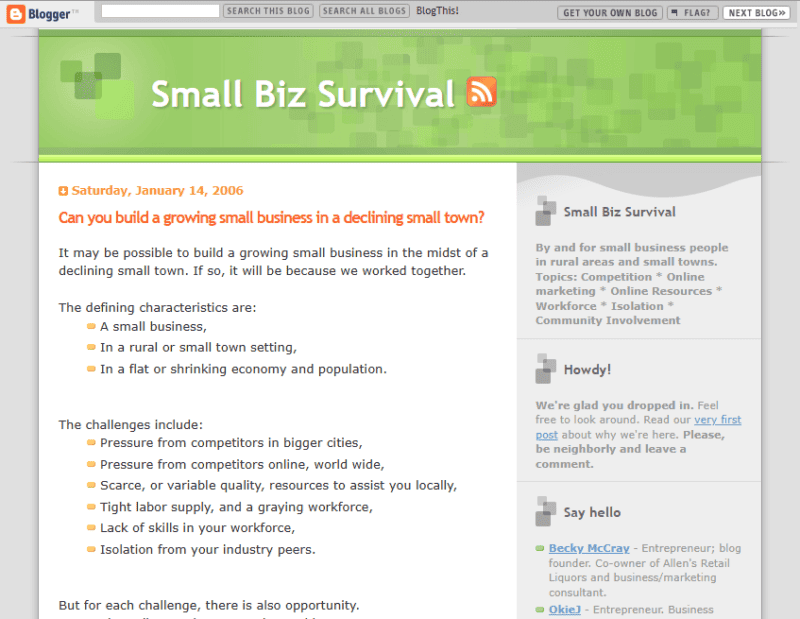
That very first post asked: ‘Can you build a growing small business in a declining small town?’ I’ve spent twenty years proving the answer is yes.
I started this blog because I’m a small town entrepreneur, and I believed then (still do) that small town entrepreneurs have a lot to teach other businesses. When local entrepreneurs prosper, they help their small town prosper, too.
That was January 14, 2006. A lot has changed since then. A lot of other blogs have come and gone. But we’re still here.
The People Who Made This Possible
I can’t talk about twenty years without talking about the people who’ve contributed their knowledge, their stories, and their time to this rural corner of the internet.
My mom, Glenna Mae Hendricks (Maesz), shared tax tips and accounting wisdom that helped so many small business owners sleep better at night. She’s since passed on, leaving a real legacy.
Jeanne Cole was one of our earliest contributors, a friend from long before I started the blog who showed up when it mattered.
Glenn Muske brought decades of Extension service experience and true expertise on micro-businesses.
Deb Brown, my co-founder at SaveYour.Town, has contributed her retail knowledge and real-world small town business experience.
And there have been so many guest contributors over the years: Jon Swanson, H.E. James, Zane Safrit, Barry Moltz, Sheila Scarborough, Marci Penner, John Warrillow, Shannon Ehlers and Scott Meyer.
What Blogging Brought Me
Here’s what I didn’t expect when I started: blogging was the step that made everything on my career goal list possible. (Of course I had a career goal list! If you know me, then you know.)
Chris Brogan was my first blog friend. He got me involved in his early podcasting projects starting with Grasshopper New Media in 2006. Then other media ventures like Owner Magazine. He’s the one who convinced me to join Twitter in 2006 when it was brand new (my user number was 10,318), back before hashtags or even @ names existed. Chris is really the biggest reason blogging turned into more for me over the years. In 2020, he came back to guest post here. Thanks, Chris!
Then there was Liz Strauss of Successful-Blog.com. She handed out Successful Outstanding Blogger awards and called us SOBs, which was hilarious. Liz connected me with so many other people. At her SOBCon event, I met Barry Moltz, who became my co-author for our award-winning book Small Town Rules. Liz got me early speaking roles at BlogWorld Expo in 2008 and ’09. We spoke together as a duo at SXSW in 2010. Rest in peace, Liz.
Those connections led to more connections. Speaking opportunities. My work with Sheila Scarborough creating Tourism Currents. Eventually, the work Deb Brown and I do at SaveYour.Town. The Survey of Rural Challenges that started as a topic survey for this blog and has now reached over 2,200 rural folks. My second book The Idea Friendly Guide. Speaking engagements from local community centers to Harvard Kennedy School and international stages.
None of that would have happened without me hitting publish on January 14, 2006.
What We’ve Built Together
The recognition has been humbling. Top 10 Best Small Business Blogs by Feedly and FeedSpot, as of today. Top 25 by Technorati for a brief moment during the height of the blog competition. Selected for syndication through LexisNexis, Thomson Business Intelligence, MyVenturePad. Named a Small Business Influencer multiple years running and a Power Player in Technology Business Media.
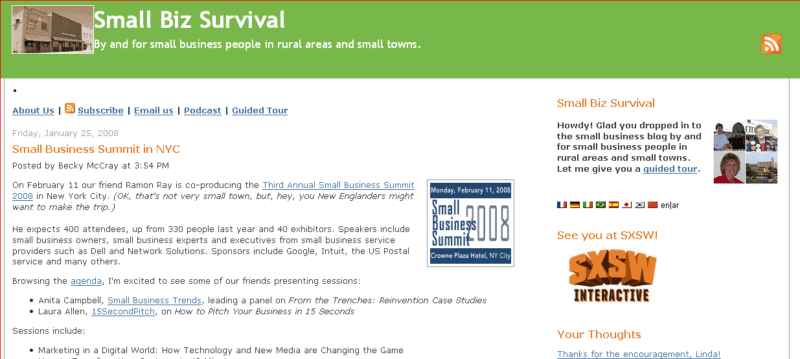
Look how SmallBizSurvival had grown by 2008!
Our long-running Brag Basket, where people shared their own successes. The podcasts, video streams and experiments. The thousands of posts from the practical to the fun.
Guest columns at US News and World Report, SmallBusiness.com and SmallBizTrends.com. (SmallBizTrends also still plugging along after 20 years!) Getting to judge small business grant entries for Intuit. Attending conferences like the National Association of Seed and Venture Funds on a media pass.
The emails from business owners who tried something they read here and it worked. The small town entrepreneurs who found practical advice they could actually use. The rural communities that discovered they weren’t alone.
Still Here, Still Rural
A lot has changed in twenty years of blogging and twenty years of rural entrepreneurship. But the core truth remains: small towns can thrive when their local businesses prosper.
Alva’s population made a resurgence in the mid 2010s (just one more oil boom), before dropping back below 5,000. I don’t have the liquor store anymore, but I’m still writing from real experience, my own successes and failures as a lifelong entrepreneur. Still focused on practical steps you can put into action right away. Still believing that when you take care of your business, you’re taking care of your community.
Here’s to the next twenty years of small biz survival.
Thanks for being part of this journey.
Get more customers without advertising: Show up where they can find you
How the Roofer Nailed Marketing Guest Post by Chris Brogan Let me tell you about an experience I had in a little diner in Lewiston, Maine. I sat at the counter of a busy Maine diner slinging breakfast to a crowd of mostly locals, it seemed. One guy a few seats away from me did […]
How the Roofer Nailed Marketing
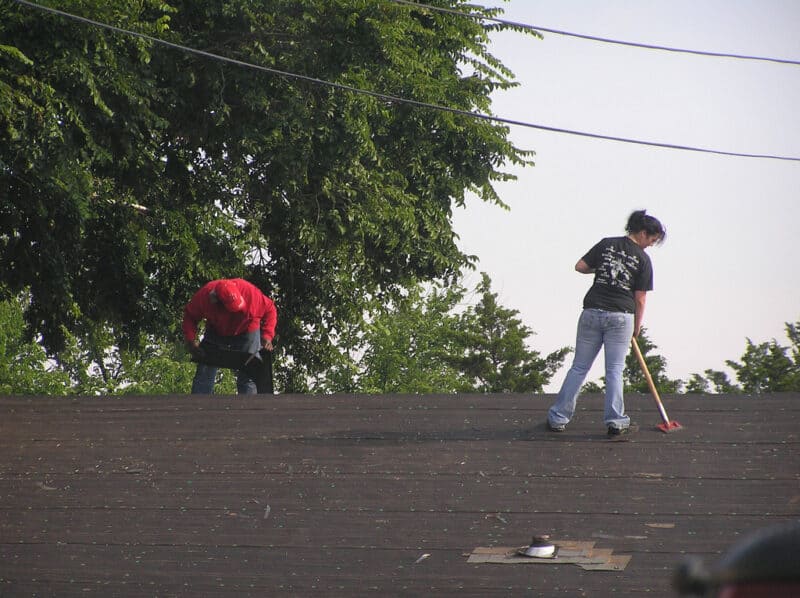
Photo by Becky McCray.
Guest Post by Chris Brogan
Let me tell you about an experience I had in a little diner in Lewiston, Maine.
I sat at the counter of a busy Maine diner slinging breakfast to a crowd of mostly locals, it seemed. One guy a few seats away from me did roof work. I know this because over the course of my meal, maybe eight different people interrupted him to ask him to check out a job they had in mind for him.
I couldn’t ignore any of this, so I asked, “I don’t want to interrupt, but you sure are getting a lot of business just sitting here at the counter. You don’t advertise or anything, do you?”
“Nope,” he said, pushing some eggs into his mouth and chewing for a little. “I come here for breakfast and lunch every single day they’re open. And every day, someone asks me if I can look at a job. Easy as that.”
Local Products Make the Best Swag

Jim Katzman wrote a great article on Medium about creating swag that customers actually want. One of his tips was “Leverage Local Pride.” That got me thinking: Local products would make the best swag. Local products are easier Instead of designing a batch of custom pens or ordering another lot of logo coffee mugs, walk […]
Jim Katzman wrote a great article on Medium about creating swag that customers actually want. One of his tips was “Leverage Local Pride.”
That got me thinking: Local products would make the best swag.
Local products are easier
Instead of designing a batch of custom pens or ordering another lot of logo coffee mugs, walk into a local shop and buy what they’ve got. Local honey. Locally made soap. Beef jerky from a nearby producer. A small art or craft piece.
You skip the minimum order quantities and the wait time. You support another local business. And you hand people something they’ll actually use and remember.
Whether you’re at a trade show, conference or heading to a special event, you can share your local flavor rather than “yet another water bottle.”
People love local products
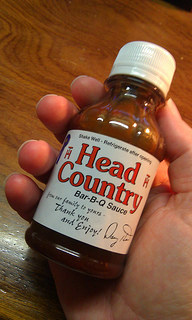
A tasty sample from Head Country sauces in Ponca City that is easy to take home.
I often give visitors Shawnee Mills cornbread mix packets when they come through Oklahoma or I visit them. Cornbread is an important cultural food to me. Even though I live a few hours from Shawnee, it’s local enough. And people love it when I share stories about my grandmother making cornbread.
That’s what local products do. At their best, they tell a story about your place.
Head Country BBQ Sauce in Ponca City, Oklahoma, once made mini 3-ounce bottles specifically as swag. Small enough to meet TSA liquid rules, so visitors could take it home even when flying.
Make it yours and theirs
You can co-brand if you want: add your sticker or tag to local sauces, seasoning mix, or whatever fits your business. Or just hand it over as-is with your business card (or your loyalty card).
Those Head Country sample bottles included some promotional text about Ponca City, done in cooperation with their economic development team. (Go, Ponca!)
Shawnee Mills actually does custom mixes, and that would be so much cooler than a generic water bottle with your logo.
When I managed a liquor store and was participating in social media conferences, I took mini 50ml bottles of liquor, added a little card from Moo printers, and used that as my calling card. People would fight over them!

My liquor store business cards for social media events. Photo by Crystal Storm.
It’s better marketing
When you give someone local products, you’re not just promoting your business. You’re showing that you support other local businesses. That’s good marketing for you and good for your community.
Next time you need swag, look local first
Walk around your downtown. Check out local makers and producers. See what’s already on the shelves at local shops. Look regionally and check out “made in your state” products.
You’ll find something better than another notebook, and you’ll be supporting the businesses around you at the same time.
How to be Idea Friendly – book review

I grew up in a small town in Maine, but I don’t think of myself as a small-town guy. My parents were involved in local community service groups. My Dad was the Cub Scout leader, a member of the Jaycees and the Elks club. And I remember helping him and other volunteers build a kiddie […]
I grew up in a small town in Maine, but I don’t think of myself as a small-town guy.
My parents were involved in local community service groups. My Dad was the Cub Scout leader, a member of the Jaycees and the Elks club. And I remember helping him and other volunteers build a kiddie pool, which literally changed the town park’s landscape.
The town I live in now isn’t small. And while I’ve been part of our local theater and coached youth basketball, I am not nearly as involved as my parents were in shaping the future of the town I grew up in.
Honestly, the idea of effecting change here seems more daunting; the thought of all the hoops, of filling forms, getting approval from committees, not to mention dealing with naysayers, doesn’t exactly inspire someone to take action.
And then, I cracked open Becky McCray’s new book and read the beginning of the Idea Friendly Creed.
“We are a community of possibilities, not of problems. We are action takers. We are optimistic.”
Those lines alone got me nodding my head, and they set the stage for a book filled with everything the subtitle of The Idea Friendly Guide promises: “Practical, Immediate Steps to Break Free from Old-Way Thinking and Transform Your Community’s Future.”
I’m also partial to some of the books’ more irreverent encouragement.
“We don’t care about titles or who holds official positions. The people who do hold titles may not think like us. That’s ok. No one can stop us from doing the little things that really matter.”
The Method
The Idea Friendly method is simple.
“Gather Your Crowd with an idea that entices others.
Build Connections to turn your crowd into a powerful network.
Take Small Steps to accomplish your idea together.”
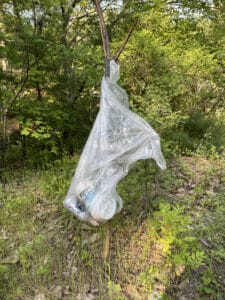
Hang a trash bag where folks hang out, and they’ll use it. Social contract repaired. Photo by Rob Hatch.
For years, I (and others) have been telling Becky that this method would work really well in all sorts of scenarios. She knows we’re right, but it’s really meant for you or for me to use to shape the future of our communities.
A while back, I wrote about taking a trash bag with me to my local fishing spot to clean up some of the cans and other trash people left behind. I also hung a trash bag from a tree and filled it with a few cans to get things started. A few weeks later, it had more trash in it, rather than scattered on the ground.
It was Becky and her method that inspired me to, in some small way, shape a tiny corner of my community. Because as the Idea Friendly Creed says, “We create the moments that show what this town could be and the places that take our breath away, if only just for a moment. What we create doesn’t have to be permanent to create possibility.”
I think that’s one of the things I appreciate most about Idea Friendly. That we can take small practical steps, that what we create can be measured in moments. And by creating those moments, those small wins, we have something we can build on.
Of course, small towns need businesses to grow. I think that’s where Idea Friendly thrives because, as great as those start-up competitions and pitch contests might be, I think I prefer the Idea Friendly perspective.
“We’d rather help 10 people try their own ideas than to hold a vote and tell everyone to support the “winner.” That might be more efficient, but efficiency isn’t our goal. Community is our goal. And we try everyone’s ideas.”
Imagine a town (or any place) where community is the goal. Sounds like a good place to start a business.
Have a great week.
Rob
P.S. Go grab a copy of The Idea Friendly Guide. It doesn’t matter if you’re not a small-town person; it’s a damn good book.

Caring is a small town business advantage

By Stephanie Ward, Firefly Coaching Caring isn’t something you can do if you’re only using it as a tactic. You can’t fake caring, either you do or you don’t. The good news is that we all have the capacity to care. It’s a state of being that you can tap into, just like gratitude. We […]

By Stephanie Ward, Firefly Coaching
Caring isn’t something you can do if you’re only using it as a tactic.
You can’t fake caring, either you do or you don’t.
The good news is that we all have the capacity to care.
It’s a state of being that you can tap into, just like gratitude.
We would probably be more caring, more often, if we just thought about it.
Like anything, it has to be a priority, something you are consciously thinking about and want to do.
So how can you show potential clients, your current clients, and the people in your network that you care?
Here are some ideas to get you started.
1) Listen
We all want to be heard. My favorite habit from Stephen Covey’s book, The 7 Habits of Highly Successful People, is Habit #5: First seek to understand, then to be understood.
Listen deeply to people when you communicate with them. Make sure they feel that you hear them and clearly get what they are saying.
2) Ask How It’s Going
Ask your clients about their experience with your products and services. Ask them if they are satisfied, if they are receiving what they expected.
If things aren’t up to snuff, do everything you can within your power to make the situation right. And then do even more to exceed their expectations.
3) Offer Help
If you see that someone is struggling with something, offer to help.
Can you share a resource that will help? Make an introduction? Review something?
Being helpful is a wonderful way to show you care.
4) Check In
Check in with people for no reason other than to say hello and see how they are doing.
You can drop a note in the post, call, or send an email.
5) Give Support & Encouragement
If you know someone has an upcoming event, book launch, speaking gig, or an equivalently big deal on the horizon – send them a message of encouragement.
Caring about the success of others is fun and easy to do.
6) Share Their Work
As the Salvation Army says, Sharing is Caring. If you care about someone, and the work she is doing, share it.
Social media makes it a piece of cake to do. So take a few minutes to share the creations of others.
7) Keep Your Promises
In business, your word is everything. Caring about someone means keeping your promises.
Keeping your promises builds trust and lets people know they can count on you.
8) Say Thank You
If someone does something kind for you, show you care by saying thank you.
Showing your appreciation goes a long way and yet, it’s another thing we sometimes forget to do.
The funny thing about caring about people is that in your effort to give, you will also receive. It feels good.
How do you show people you care?
© Stephanie Ward, reprinted by permission
Photo PD by Alex Starnes, via nappy
Stephanie Ward is the Marketing Coach for Entrepreneurs who want to create meaningful and prosperous businesses. Grab your FREE copy of the special report ’7 Steps to Attract More Clients in Less Time’ plus business building tips, at: https://www.fireflycoaching.com.
Which one of these ideas will you try? How do you show your clients you care? Share your experiences, thoughts, and questions in the comments section below.
Start smaller: Any local business can be your incubator
Are you starting a business that could use retail space, but you can’t justify renting a storefront? Find a tiny space inside another business that can be your incubator. Who could display This can work for all kinds of physical-display businesses: Artists Crafts Authors Resellers Photographers Shelf stable foods and beverages Small manufacturers Agri-products like […]

Are you starting a business that could use retail space, but you can’t justify renting a storefront? Find a tiny space inside another business that can be your incubator.
Who could display
This can work for all kinds of physical-display businesses:
- Artists
- Crafts
- Authors
- Resellers
- Photographers
- Shelf stable foods and beverages
- Small manufacturers
- Agri-products like beeswax candles or goat milk skin care
Who could host
And any kind of bricks and mortar business could host:
- Retail stores
- Lodging
- Coffee shops and restaurants
- Services like insurance or legal offices
- Cultural spaces like museums
The host business doesn’t have to be related to the pop-up. In fact, when they’re not related, both sides benefit from exposure to both sets of customers.
Many small town businesses struggle to keep enough merchandise on display to make the store feel full and vibrant. Adding a pop-up business can help fill out the interior.
Together, you’re creating an experience for your customers that they can’t get anywhere else.
See also: How do you get merchants to host pop-ups inside their business?
Start with one wall, one shelf, one square foot of retail space. Here are some pictures to inspire your creativity.
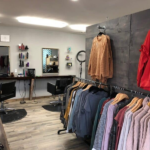
Photography in a clothing store

It’s tough for retail stores to fill the space near the ceiling, and any empty space makes a small town business look sparse. Solution: local photography display. Photo by Deb Brown
One square-foot retail
Beauty salons are natural business incubators. Salons always have other little businesses growing inside them because they have great foot traffic. This is an opportunity to do more with the same amount of space.
Probably the smallest pop-up I’ve seen is this stack of headbands, crafted by a local high school senior raising money for her mission trip. It fit into one square foot of the retail counter.

You don’t need much to start small. Even one square foot of space may be enough. Photo by Becky McCray.
The One Wall Bookstore
I love the one-wall bookstore idea! How many times have people said your town is too small for a bookstore? You’re not too small for anything if it only needs one wall!
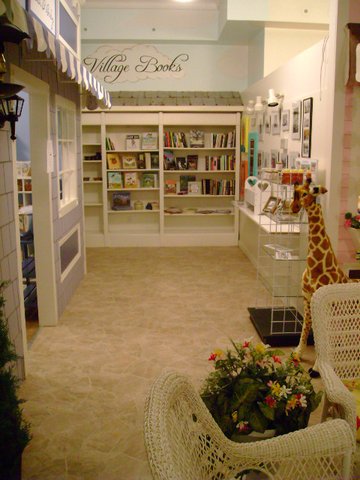
One wall of shelves made a flexible pop-up space inside The Village shops in Washington, Iowa. Photo by Cathy Lloyd
A building of tiny shops
Besides the one-wall kids’ bookshop, this building is divided into many different small retail shops.

Another one-wall bookstore, this time for kids books. Photo courtesy of Walker Mercantile, Woodward, Oklahoma
Local art and photography
Every local business (retail, service, office…) needs art on their walls. Every local artist needs to get in front of new customers. Put those together, and you have an amazingly easy local art project.

Coffee shop Gathering Grounds displays local art on the walls in Avon, Minnesota. Photo by Deb Brown
Fill just one shelf
A local hobby farm doesn’t need a full retail store for their goat milk products. One section of an endcap display in the local pharmacy may be just right.

This pharmacy obviously hosts a lot of different businesses. Photo by Deb Brown.
Start ’em young
Anyone with even a few products can display on a shelf. This high school student displayed insider their local salon.

High school student Rebecca has her own shelf of skin care products inside a local salon. Photo by Deb Brown.
Make a visual change from the host business
Use a different type of flooring, and it will look like a store-within-a-store. Don’t miss the rack of books by the local author.
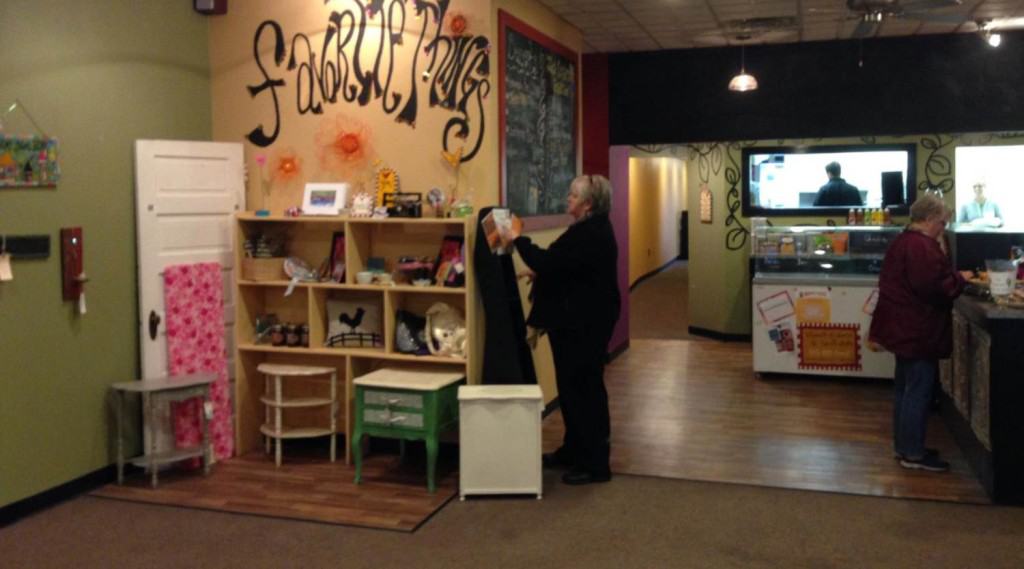
This bakery hosts a pop-up decor business tucked into a corner and a book rack from a local author, in Webster City, Iowa. Photo by Becky McCray.
Provide products that are hard to find locally
For resellers, consider products that aren’t offered anywhere else in your town, like hardware items.

Small towns double up: this aisle of the grocery store is a tiny hardware store. Photo by Deb Brown.
Fill every corner
Even lodging and B&Bs can host pop-ups.

I caught this tiny store inside a B&B where I was staying. There’s a variety of vintage items, paper goods and more. Photo by Becky McCray.
Add one shelving unit

Inside the Chickasaw Cultural Center, one shelving unit offers canned and packaged foods for sale. Photo by Becky McCray.
Divide a building and share

This clothier also has a full size coffee bar. Photo by Becky McCray.
Archives
- September 2026
- August 2026
- June 2026
- May 2026
- April 2026
- March 2026
- February 2026
- January 2026
- November 2025
- October 2025
- June 2025
- April 2025
- March 2025
- February 2025
- December 2024
- October 2024
- September 2024
- August 2024
- June 2024
- May 2024
- April 2024
- March 2024
- January 2024
- December 2023
- November 2023
- October 2023
- September 2023
- August 2023
- July 2023
- June 2023
- May 2023