Monthly Archives: February 2026
Small town marketing secret: Have something to invite people to

People need a compelling reason to leave their homes and come experience your business with you. This feels like a very heavy lift. . You’re supposed to be exciting enough to pull people away from their phones, their families and the comfort of online shopping. You’re competing with everything else demanding their attention. Here’s the […]
People need a compelling reason to leave their homes and come experience your business with you. This feels like a very heavy lift.

A local furniture store hosts two temporary businesses for a special shopping event, combining business-in-a-business and pop-ups to give more people a reason to leave their house. Photo by Becky McCray.
.
You’re supposed to be exciting enough to pull people away from their phones, their families and the comfort of online shopping. You’re competing with everything else demanding their attention.
Here’s the big secret: You don’t have to create all that energy yourself.
Piggyback on What’s Already Happening
Your community probably already has regular events that pull people out of their homes.
Art walks. First Fridays. Girls night out shopping events. Farmers markets. Chamber mixers.
People are already planning to attend these, or thinking about it. Some are already coming downtown or to your area.
Your job is to give them one more reason to show up.
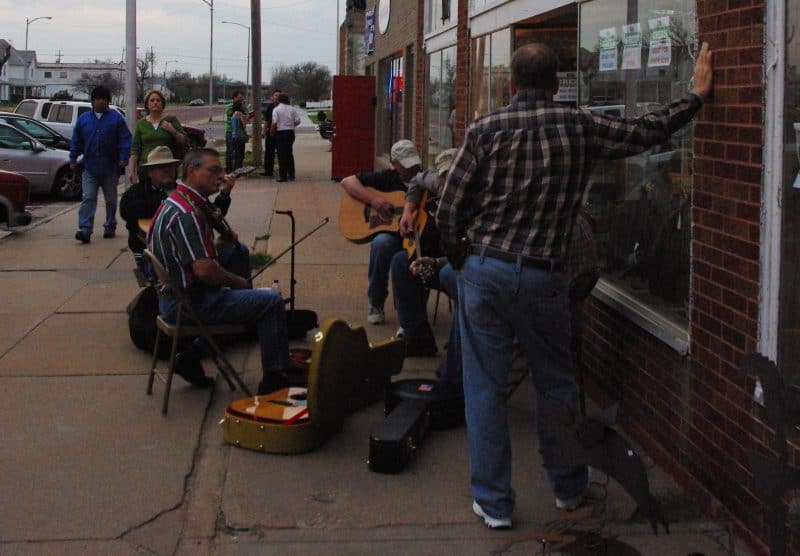
Sidewalk musicians give just one more reason for customers to leave their homes and join the experience. Photo by Becky McCray.
.
What Doesn’t Work: Just staying open during the community event
No experience. No transformation. Just… open, like you are every other day.
That’s not enough.
What Does Work: Make a Thing out of it
You have to create something special that happens during that regular community event. Here are ideas:
- Demos – Product demos, technique demonstrations, how-to sessions
- Mini services – super quick fashion nails, or 5 minute financial boost
- Meet the experts – A real estate agent hosting “meet the lenders.” A feed store bringing in a vet for cattle health Q&A during the farmers market.
- Workshops or mini-classes – Quick skill-building sessions people can actually use. Sounds like a lot for a shopping day, so keep it light and quick.
- Make and take projects – People love leaving with something they created
- Trunk shows or special collection reveals – Show merchandise you don’t normally carry
- Live entertainment – Music, performances, even personal star chart readings (yes, really – Gen Z is into astrology and all that)
- Tasting or sampling events – Let people experience your products
- Q&A sessions or “ask me anything” – Be available for real questions
- Behind-the-scenes tours – Show them what they don’t normally see (people love back room tours)
- Out of town big names – Bring in expertise people want to hear from
Pick one. Make it yours. Do a fresh edition of it every time that community event happens.
You become the tipping point
Someone was thinking about coming to art walk. Then they heard you’re doing that demo they’ve been curious about. Now they’re definitely coming.
You’re not competing for attention. You’re adding value to something people already plan to attend. Or at least thought about attending.
And here’s your new go-to move: When anyone expresses interest in your business but never seems to make it in person? Don’t just “follow up.” Invite them to your special thing during the next community event.
“Hey, I’m doing a live demo during First Friday – would love to see you there!”
You still have to do your regular marketing like mailing postcards, sharing photos, but you’re supercharging it with a deadline. And then you’re layering it with repeated messages.
“Our demo was packed! We’re doing another (a little different) next month!”

Frame shop owner Carolyn Murrow hosted a local photographer in her business’s foyer during an evening art walk in Alva, Oklahoma. Photo by Becky McCray.
The Small Town Reality: Fewer people, less turnout
Yes, rural areas have fewer people. That means fewer potential attendees. Less momentum each time. It’s harder to keep events going on your own.
That’s exactly why piggybacking on existing events is brilliant for small towns. The event is already happening. People are already considering attending. You’re just giving them one more reason to come.
Start Small, Keep Going
- Pick one existing community event.
- Create one simple thing to offer during that event.
- Commit to showing up consistently with your thing every single time.
That’s it. That’s the whole strategy.
You don’t need elaborate planning or big budgets. You need one good reason for people to experience your business, timed to when they’re already planning to be out.
The Opportunity: Most businesses aren’t doing this.
Some businesses might stay open during community events. But most are not creating experiences.
You will stand out.
When you’re the business that always has something interesting happening during art walk, or First Friday, or girls night out – people start planning around you. You become part of why they attend the community event in the first place.
So what’s your thing? And which community event will you tie it to?
More experience-based retail: the Charm Bar, Valentine’s Rose Bouquet Bar

Following up on the trend of rural experience-based retail, I spotted these Valentine’s Day offerings from my local women’s boutique, The Daisy Village. I’m seeing more and more use of the term “Bar” to refer to any assemble-your-own type experience. Think like a salad bar, where you pick just the parts you want, but for […]
Following up on the trend of rural experience-based retail, I spotted these Valentine’s Day offerings from my local women’s boutique, The Daisy Village. I’m seeing more and more use of the term “Bar” to refer to any assemble-your-own type experience. Think like a salad bar, where you pick just the parts you want, but for anything from western hats to charm bracelets.
Experiences are a competitive advantage for small town businesses.
The fun of picking your own ingredients and assembling your own product, plus knowing no one else will have one just like yours, equals an experience that online shopping can’t replace. That’s a competitive advantage.

They combined a pop-up from a bakery with a chance to customize and pickup your rose bouquet. Perfect Valentine’s Day retail ideas.
In the same email, the Daisy announced a new Charm Bar so you can pick the charms you want on your jewelry.

Assemble-your-own experiences build community.
While you’re shopping, picking out your own favorite pieces and assembling with your own personal touches, you’re also talking to other people and being physically present in the community. That helps build a strong local community. It’s part of why shopping locally matters to rural places.
Buy Inventory Online Using Wholesale Apps: Tips for Small Town Retail Stores
I walked into a new local retail shop in Alva, Oklahoma, population 4,000. It’s called Bates & Co., and they are best known for their handcrafted hairbows for infants and kids. But when I walked into their store, they had all kinds of things under one roof: women’s clothes, fashion jewelry, travel accessories and more. […]
I walked into a new local retail shop in Alva, Oklahoma, population 4,000. It’s called Bates & Co., and they are best known for their handcrafted hairbows for infants and kids.

Bates & Co used to be Bates & Bows, known for these amazing hairbows. Photo by Becky McCray
But when I walked into their store, they had all kinds of things under one roof: women’s clothes, fashion jewelry, travel accessories and more. It was a rural women lifestyle kind of shop. I asked the owner where she found all her products, did she go to the Dallas Markets to find them? She said no, she bought from the wholesale apps on her phone.
I was floored! I used to run a retail liquor store, and we could only purchase from approved wholesalers licensed by the state. I had no idea the power of a simple wholesale app on your phone!
So I bet there are other business owners or hopeful future store owners who don’t know that either!

From their beginnings with hairbows, Bates & Co now leverages wholesale apps for inventory that covers a wider rural lifestyle niche. Photo by Becky McCray.
Wholesale apps are your trade show that never closes
If you’ve only ever bought inventory through licensed distributors or in-person markets, this feels almost unreal. But for many retail categories — especially clothing, gifts, accessories, home décor, and boutique-style items — there are wholesale marketplaces that live right on your phone.
And no airfare or hotel bill.
That’s powerful in a town of 4,000.
But it also means you need to be a smart buyer.
Green flags: signs a wholesale app is worth your time
I did a little research on this, and I’m excited about the potential for rural retail businesses! If I were starting with these apps today, here’s what I’d look for first:
Clear wholesale requirements
Legit apps usually require:
- A business name
- An EIN or business registration
- Sometimes a resale certificate
That’s a good sign. It means they’re trying to keep retail shoppers out of the wholesale pool.
Transparent pricing and minimums
You should see:
- Wholesale prices clearly marked
- Reasonable minimum order quantities (MOQs)
- The ability to test with a small first order
You don’t need massive quantities in your small town boutique, so look for apps that understand that.
Real brand information
Look for:
- Brand story and location
- How long they’ve been on the platform
- Reviews from other shop owners
If you can’t tell who you’re buying from, slow down.
Shipping timelines you can live with
Some items ship in days. Others are preorder and ship in weeks. Both are fine — as long as it’s clearly stated, and as long as that works for your business.
Red flags: when to delete that app
These are the things that would make me nervous:
Prices that don’t seem right
If the “wholesale” price is what you’d expect to pay at Walmart, something’s off. Either quality will disappoint, or you’re not really buying wholesale.
No clear return or damage policy
Stuff happens in shipping. If there’s no explanation of what happens when it does, assume you’re on your own.
Retail customers mixed in
If the app openly sells single items to consumers and claims to be wholesale, that’s a warning sign. It puts you in direct competition with your own supplier.
Pressure tactics
Countdown clocks, “only 3 left!” warnings, or constant push notifications are designed to lead to bad buying decisions. Does it remind you of a gross online casino? Delete it and move on.
Use apps to multiply your local advantage
Small-town retailers like you actually have built-in advantages when it comes to using wholesale apps, advantages that big-city shops often don’t.
You don’t need to win on volume because you win by knowing your people.
You’re smaller. You’re closer to your customers. And you’re used to paying attention.
That makes these apps more useful to you, not less.
You can test without betting the farm
Big-city stores often need big orders to justify shelf space and staffing. They live and die on volume. In a rural shop, you can bring in a handful of scarves, see what happens, and decide from there.
That makes low minimum orders a feature, not a limitation.
You can move faster than chains
Corporate retail plans seasons months in advance. You can react in real time. If customers start asking for cute new bags or travel accessories, you can go looking that afternoon.
That kind of responsiveness is hard to match.
Fill gaps alongside your unique local flavor
Take a moment to appreciate the unique local flavor you create in your store. You offer experiences and items that can’t be bought online.
Your locally-produced items, personalization and special services give you an advantage.
In store classes, demonstrations and hands-on crafts are memorable experiences that no online competitor can copy.
Use these new apps to add even more value, not to replace your amazingness.
Wholesale apps drive down the cost of distance
In the past, rural retailers were fighting to catch up to trends because markets were far away, minimums were too high and there was always too much to do.
Wholesale apps flip that. You can now buy the same styles as a boutique in any big city, without leaving your store and without waiting for the next big trade show.
That doesn’t guarantee success, but it removes one huge barrier.
What’s your take?
If you’re using wholesale apps in a small town, I’d love to hear which ones you’ve tried and what surprised you. Or your challenges, tips or what to avoid.
Archives
- March 2026
- February 2026
- January 2026
- November 2025
- October 2025
- June 2025
- April 2025
- March 2025
- February 2025
- December 2024
- October 2024
- September 2024
- August 2024
- June 2024
- May 2024
- April 2024
- March 2024
- January 2024
- December 2023
- November 2023
- October 2023
- September 2023
- August 2023
- July 2023
- June 2023
- May 2023